Sami Parker Online

Books, Commentary, and Magic

Menu
  • Home
  • Commentary
  • Books
    • Book Reviews
    • Reading Challenges
    • Authors
  • Consulting
  • Policies
  • About
    • FAQs
    • Contact Us!
Menu

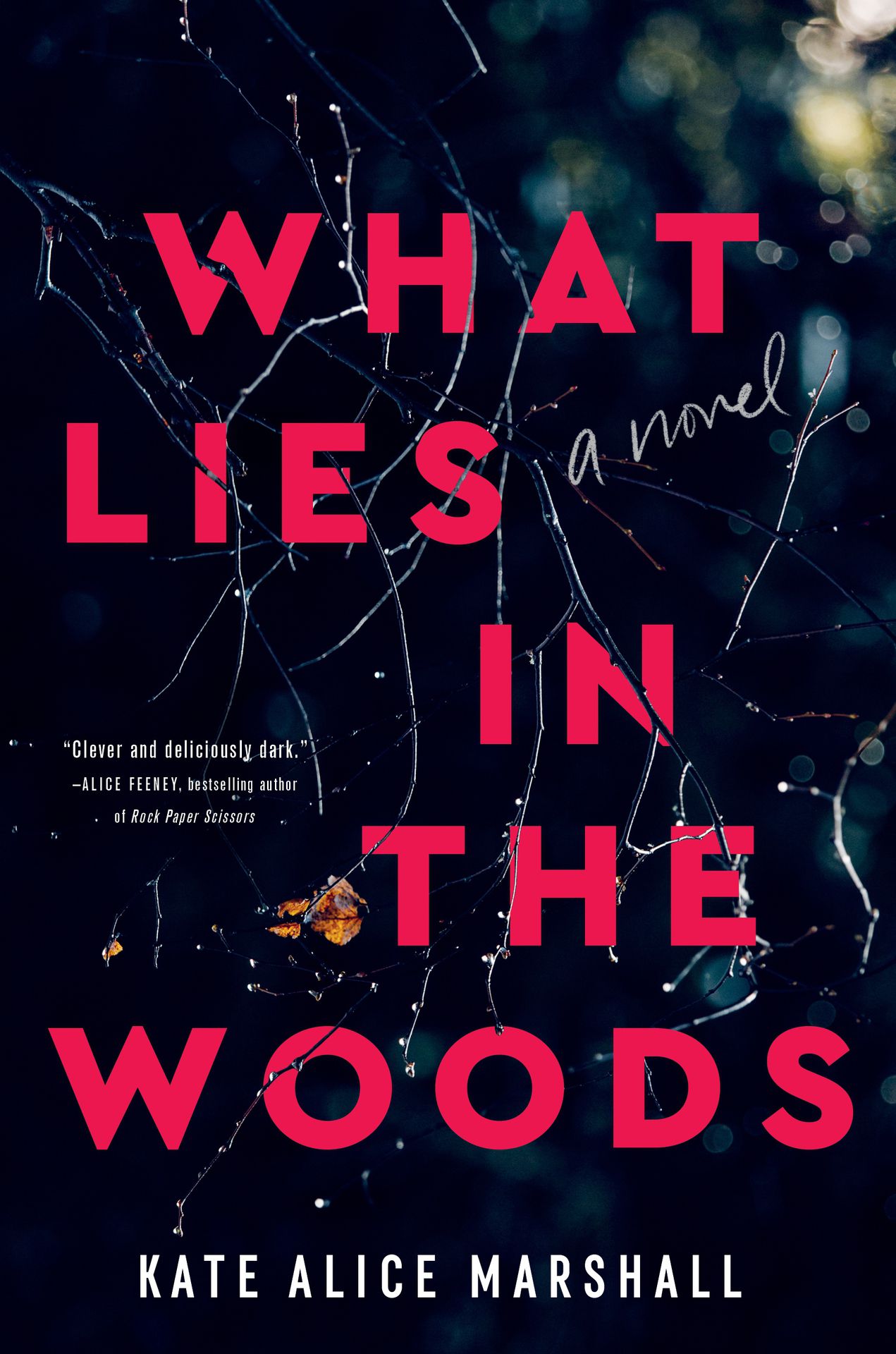
Review: What Lies in the Woods

Posted on March 15, 2026March 15, 2026 by Sami
  • Heat scale: 2.5 out of 5
  • Scare scale: 3.5 out of 5
  • Violence scale: 4 out of 5
  • Score: 9.3
  • Grade: A-

Author – Kate Alice Marshall
January 17, 2023
Flatiron Books
Hardcover – 336 pages, $28.99, found at $20.25
Paperback – 336 pages, $18.99, found at $10.55
Kindle – 326 pages, $11.99
available on Kindle Unlimited as of 3/15/25
Audiobook – $26.99, found at $14.17 (11h, 29m)
Other digital formats may be available.

Publisher’s Description:
Naomi Shaw used to believe in magic. Twenty-two years ago, she and her two best friends, Cassidy and Olivia, spent the summer roaming the woods, imagining a world of ceremony and wonder. They called it the Goddess Game. The summer ended suddenly when Naomi was attacked. Miraculously, she survived her seventeen stab wounds and lived to identify the man who had hurt her. The girls’ testimony put away a serial killer, wanted for murdering six women. They were heroes.
And they were liars.
For decades, the friends have kept a secret worth killing for. But now Olivia wants to tell, and Naomi sets out to find out what really happened in the woods—no matter how dangerous the truth turns out to be.

My Notes:
Kate Alice Marshall blends sharp twists, haunting atmosphere, and unreliable memories into a tight narrative that will have you questioning each character’s version of events while slowly peeling back layers of buried secrets. Liv, Naomi, and Cass. Athena, Artemis, and Hecate. When the man they sent to prison dies, it sets off long-put-off questions, and it starts unraveling just who Persephone is and how she fits into more than just a children’s game.

Location/Setting:
Some bits in Seattle, Washington, with the main body of the story in Chester, a small town in the Olympic Forest.

Diversity:
There is much more economic and cultural diversity than racial or ethnic diversity. There is one Japanese character who is given a bit of the exotic, and her husband is seen differently for having brought an “other” wife into the community. One of the main characters is bisexual, but it is in a few easily missed comments, and she only has boyfriends on the page. All other characters are depicted as cis and hetero.

What genres would this book fit in? Thrillers, Mystery, Horror

From whose point of view is the story told? Naomi Cunningham, one of a group of three best friends since kindergarten, and the one who survived being stabbed seventeen times that day in the woods when she was eleven. The book starts a couple of decades later.

Has this book been banned? It is not on any of the banned lists I have access to.

How are non-white people treated? There is only one explicitly non-white character in the book, and she is treated rather well for a small town not used to outsiders moving in, though some still note the differences.

How are GLBT+ people treated? There is only one explicitly non-cis/hetero character, and though her bisexuality is noted several times, it is not hard to miss.

Is there neurospicy / disabled representation? There are a couple of characters that are depicted with noted mental illness, one of whom is handled pretty well, and one of whom has a very complicated relationship with the narrator.

Scoring:
Plot = 1.0 – I was impressed with how the author kept such a busy plot clear in the telling. The many twists and turns make sense in the moment, and the conclusion is not out of the blue.
Characters = 0.9 – There is a larger cast, but all of the characters have a distinct feeling and voice. Some are more well-developed than others, but I had no trouble keeping track of everyone throughout the story.
Setting = 1.0 – The small town does not have a great deal of description, but it fits the small-town mold well, and all the necessary exposition is there. The woods, however, are almost another character in themselves – descriptions weave in and out with the magic of childhood imagination and with the chill foreboding of a good bit of horror, switching back and forth depending on the point of view and the place in the story.
Pacing = 0.8 – The story starts slowly, then speeds up within a couple of chapters. By the end it is galloping. It would have been a bit smoother if the pace had been more even, but the shift wasn’t enough to throw me out of the story.
Ending = 0.9 – The ending makes sense and is foreshadowed enough to not be too much of a surprise. The earlier twists and turns fit into the final ending in a sensible way. There is a bit of fortuitous timing near the end that stretches credulity a bit, but it didn’t break anything for me. I liked the very last bit and the possibilities it left for several of the characters.
Emotional Impact = 0.9 – At least some emotional elements in the story should resound with a majority of readers. The author does well with catching the magic of children’s games, and with how memory can play tricks on you about trauma and about secrets.
Writing Style = 1.0 – I was impressed with the clarity of each character, the handling of the very busy plotline, and with the simple but lush descriptions. The author has a distinct voice that I enjoyed reading, and that drew me back to the story quickly when I had to put it down for “real life” things.
Themes = 0.8 – Overall I think the themes are well-handled and don’t beat the reader over the head, but a couple of places that got a little more heavy-handed than usual brought this score down a little.
Other Scales = 1.0 – The levels of heat, scare, and violence are appropriate to the story, and the elements flow well with the storyline.
Overall Enjoyment = 1.0 – This is one I’m glad to have read, and really enjoyed. I’m sorry it sat on my TBR so long! I recommend it to readers who enjoy unreliable narrators, creepy woods, small town secrets, hidden identities, and second chances. It won’t work well for folks who are looking for greater diversity, straight plot lines, or clear endings. I am looking forward to re-reading this in a year or so, when the detail will be a bit fuzzy, to see what else I pick up in it.
Total Score = 9.3

Heat:
2.5 out of 5 – There is little explicit detail, but some sexual elements are important to the plot. There is some lightly described sexual tension, with some minimal detail and/or euphemism in descriptions of physical affection or sex. May have some rougher dirty talk.

Scare:
3.5 out of 5 – Has some mild graphic detail in fistfights or in violence with weapons. Has instances of intense verbal conflict. May have some graphic disturbing content that might be a little hard to read at times. If you were to explain the twists in this story to someone who didn’t read thrillers, you’d need to leave quite a bit out.

Violence:
4 out of 5 – Has graphic violence. On page events have some graphic detail. Has multiple instance of described violence. May be unsettling to some.

Grade:
A- – Highly recommended to folks who enjoy this story type. (It’s not a general interest read!) Well done, and highly enjoyable for its category. I will definitely be telling some of my friends that they really need to read this one, and I’m looking forward to discussing it with them.

Tests:
Bechdel = pass – There are a number of conversations between the girls as both children and adults that don’t involve men, as well as several conversations with more minor characters.
Mako Mori = pass – The girls stories are definitely not about supporting a man’s story, although a man’s story does intersect with them.
Deggans = fail – there is only one noted non-white character in the main cast
Vito Russo = pass, sort-of – there is a non-hetero major character, but there is nothing notably non-hetero on page
Babs and Kara = pass – all 3 of the girls/women have sufficiently developed personalities that they could be distinguished within a few sentences if they were to speak from behind screens
Finkbeiner = pass – the main women are depicted in multiple ways separate from their relationships with males or children, although the main reason they are known outside of their community is based on their relationship to one man
Fridge = pass – No woman’s suffering or death is used to initiate or progress a male character’s storyline.
Sexy Lamp = It’s complicated – None of the main woman characters could be replaced by a sexy lamp with a post it note on the shade, but a couple of minor woman characters could.
Ars Marginal = pass, mostly – The single explicitly non-white character is framed to some extent by her differences, but there are major elements of her part of the story that have nothing to do with her ethnicity.
Roxane Gay = pass – There are central woman character(s), with at least one supporting woman character, who does not compromise herself for love, or who doesn’t live extravagantly for no explained reason

About the author:
Kate Alice Marshall is the bestselling author of thrillers and horror for kids and adults. Her middle grade books include the Secrets of Eden Eld trilogy and Extra Normal. In YA, she’s written the survival thriller I Am Still Alive, as well as supernatural suspense including Rules for Vanishing and The Narrow. She made her adult thriller debut with What Lies in the Woods, followed by the USA Today bestseller No One Can Know.
She lives outside Seattle with her family, two very friendly (but not very smart) golden retrievers, and a growing collection of fancy pens. 

Review: Trust Me On This

Posted on May 26, 2025May 26, 2025 by Sami
  • Heat scale: 1 out of 5
  • Scare scale: 0 out of 5
  • Violence scale: 1 out of 5
  • Score: 8.6
  • Grade: B+

Author – Lauren Parvizi
April 8, 2025
Lake Union Publishing
Paperback – 367 pages, $16.99
Kindle – 356 pages, $4.99
available on Kindle Unlimited as of 5/25/25
Audiobook – $42.99, found at $30.09
Other digital formats may be available.

Publisher’s Description:
Zahra Starling and her younger half sister, Aurora, have nothing in common. Not their childhoods or their personalities. And certainly not their outlooks. After a terrible loss, Zahra prefers the solitude of her LA kitchen to people, especially family. Bubbly Aurora, a rising Hollywood starlet, has everything she’s ever dreamed of, except a relationship with her sister.
Then comes a plea from their dying father, who wants both daughters by his side. He has a secret to share that’s been a long time coming.
It’s Zahra’s last chance to bring closure to the past, even if traumatic memories mean there’s no way she’s stepping foot on a plane. For Aurora, road-tripping to Seattle is the perfect escape and the chance to win over prickly Zahra.
What starts as a rough ride reopening old wounds evolves into something neither expects. When they finally reach their destination—and the truth that awaits them—the sisters will need each other like never before.

My Notes:
This book can be a good read if you can put the lack of noted diversity aside. I enjoyed the road trip format, and the increasing connection as the trip went along. The younger sister is quite naive at the start of the story to an extreme level but given her circumstances and personality as they become apparent through the story it doesn’t read as overly off. There is significant character growth in sometimes abrupt ways, but it doesn’t read as overly jarring in the storyline. The descriptions of food and flavors are lovingly and wonderfully done; my mouth watered, and I wished I could really taste some of the dishes. I loved how food is related to family and heritage, as well as to personal connections and sharing one’s self with others. I grew up with food as a point of heritage and a family connection as well, and this brought back good memories. Overall, there are a few flaws, but it is a good story.

Location/Setting:
Mostly on major roads (with a few minor offshoots) between Los Angeles, California and Seattle, Washington. There are some stops along the way, with bits specifically in LA, and a few bits specifically in Seattle.

Diversity:
The youngest sister is white. The older sister is half-Iranian, with “dark dyes, dark hair, browner skin, and better cheekbones” than her white father or sister. Based on interactions in the story, she is not so dark as to be on the receiving end of prejudice the majority of the time. Several other characters have names that are not usually given to folks of white heritage, but descriptions do not include enough features to tell if they are non-white or not. Both sisters are cis/hetero. There is no mention of any characters being anything other than cis and hetero.

What genres would this book fit in? Women’s Fiction, Family Dramas, Road Trips, Contemporary Fiction

From whose point of view is the story told? The POV alternates between the two sisters.

Has this book been banned? It is not on any of the banned lists I have access to.

How are non-white people treated? Defined non-white people are nonexistent.

How are GLBT+ people treated? Defined queer people are nonexistent.

Is there neurospicy / disabled representation? Defined neuro/dis people are nonexistent.

Scoring:
Plot: 0.8 – Solid, with a couple of less-likely choices that do not break the flow of the story
Characters: 0.8 – Interesting without being over the top a majority of the time
Setting: 0.9 – Mostly car interiors, but enough local color to fit the storyline
Pacing: 0.9 – Good general pacing without significant lulls or speed runs that effect the story flow
Ending: 1.0 – It works. Most questions answered, with reasonable emotional payoff. The epilogues are well done and tie things up well.
Emotional Impact: 0.8 – Most readers should be able to feel for one or both siblings. At least some emotional elements in the story should resound with a majority of readers.
Writing Style: 0.8 – Easy to read and follow. Style is concise, bordering on minimal, and is consistent throughout. There are very few areas where verbiage gets in the way of story flow.
Themes: 0.8 – For the most part themes are well-woven into the story. Most themes are reasonably explored for the storyline, but there are a few superficial areas. Theme development does not get in the way of the story.
Other Scales: 1.0 – The levels of heat, scare, and violence are appropriate to the story, and the elements flow well into the storyline.
Overall Enjoyment: 0.8 – I enjoyed reading, and recommend this book to readers who enjoy family drama, sister stories, slice-of-life stories, rebuild relationships, second chances, stories with food as an integral part of the story, or women’s fiction and who are able to deal with the lack of noted diversity on most fronts. I will probably reread this book at some point.
Total Score 8.6

Heat:
1 out of 5 – Has some brief descriptions of romance and physical affection. There is some lightly described romantic or sexual tension. Has minimal detail in descriptions of physical affection or sex.

Scare:
0 out of 5 – A walk in the park. Focus is on solving plot puzzles and related plot elements. May have some suspenseful moments, but nothing overtly scary.

Violence:
1 out of 5 – Very light violence. May have a slap, or physical shoving, or similar. No violent deaths on page. May have some lightly intense verbal conflict. May have death on page without graphic detail.

Grade:
B+ – Very good. A few flaws that may or may not influence the plotline, but are less likely to kick you out of the story. Recommended, but without jumping up and down and shoving it at people.

Tests:
Bechdel = pass – although a lot of conversations between the sisters are about their father and past/future relationships, there are a number of conversations that are not about their father or mates, and there are several conversations with minor characters that pass the Bechdel test
Mako Mori = pass – both sisters have a narrative arc that is not about supporting a man’s story (One of the plotlines is explicitly about removing someone from a situation that is beneficial to a man to the detriment of the woman.)
Deggans = fail – there are no noted non-white characters in the main cast
Vito Russo = fail – there are no noted non-cis/hetero people in the main cast
Babs and Kara = pass – both sisters have sufficiently developed personalities that they could be distinguished if both were to speak a bit from behind screens
Finkbeiner = pass – both sisters are depicted in multiple ways separate from their relationships with males or children
Fridge = pass – No woman’s suffering or death is used to initiate or progress a male character’s storyline.
Sexy Lamp = mostly pass – None of the main woman characters could be replaced by a sexy lamp with a post it note on the shade, but several other woman characters could
Ars Marginal = fail – There is not a named character that is noted as being non-white.
Roxane Gay = pass – There are central woman character(s), with at least one supporting woman character, who does not compromise herself for love, or who doesn’t live extravagantly for no explained reason.

About the author:
Lauren Parvizi won the 2024 Women’s Fiction Writers Association STAR award in the Debut category for her book “According to Rose”, and has also written the book “La Vie”. She has an MFA from San Francisco State University and has worked as a digital editor and content writer for more than a decade. She lives in San Francisco with her husband and sons.

Story Tests

Posted on May 26, 2025May 26, 2025 by Sami

In evaluating character agency and diversity, I use the following tests in my reviews:

  • Bechdel – Do two named woman characters have at least one conversation that’s not about a man?
  • Mako Mori – Does a female character get her own narrative arc that is not about supporting a man’s story?
  • Deggins – In a story that is not about race, are there at least two non-white characters in the cast?
  • Vito Russo – Does a story contain a lesbian, gay, bi, nonbinary, or trans character, who is not predominately defined by their orientation or identity, who is important enough to affect the plot?
  • Babs and Kara – Would the women characters be recognizable even if they were wearing identical bathrobes that disguised their figures and had their hair completely covered?
  • Fridge – Is a woman’s suffering or death used to initiate or progress a male character’s storyline?
  • Sexy Lamp – Can significant woman characters be replaced by a sexy lamp with a note on the shade without significantly changing the plot?
  • Ara Marginal – Is there at least one named non-white character whose primary trait is not their race and who does something important besides help a white person?
  • If based on real-life people: Finkbeiner – Is a real-life woman depicted on her own merit rather than her relationship with a male spouse or her children?
  • If a woman lead: Roxane Gay – Is there a central woman character, with at least one supporting woman character, who doesn’t compromise herself for love, or who doesn’t live extravagantly for no explained reason?
  • If a trans lead: Topside – Does the story contain more than one trans character? Do some of the trans characters know each other? Do these characters talk to each other about something other than a transition-related topic or procedure?

Violence Scale

Posted on May 26, 2025November 1, 2025 by Sami

When setting a violence score for a book, I use this scale:

  • 0 – No notable physical violence. May have mild verbal conflict.
  • 1 – Very light violence. May have a slap, or physical shoving, or similar. No violent deaths on page. May have some lightly intense verbal conflict. Characters may have guns or other weapons, but they do not cause death on page. May have nonviolent death without notable detail.
  • 2 – Some milder violence. May have a fistfight, or a simple fight with guns or other weapons. No graphic death on page. May have more intense verbal conflict. May have death with some non-graphic detail.
  • 3 – Has notable violence. May have on page violent death without significant graphic detail. May have some mild graphic detail in fistfights or in violence with weapons. May have multiple instances of intense verbal conflict.
  • 4 – Has graphic violence. On page deaths with some graphic detail. Fights are described with some graphic detail. Has multiple instances of described violence. May be notably unsettling.
  • 5 – Violence is an integral part of the plot and is described in graphic detail. Characters may be subjected to intense violence, possibly including torture and/or sadistic elements. Possibly unsettling to most readers. May not be suitable for many readers.

Scare Scale

Posted on May 26, 2025November 1, 2025 by Sami

In choosing a scare (fright, horror) score for a book, I use the following scale:

  • 0 – A walk in the park. Focus is on solving puzzles, mysteries, or related plot elements. May have some suspenseful moments, but nothing overtly scary.
  • 1– Contains some suspenseful moments and mild tension, but not overtly scary elements. May have a couple of minor scares, but this would not be considered scary or horror if it were a movie.
  • 2 – May have some unsettling scenes. Psychological elements, darker themes, and/or eerie scenes may be introduced. It may start to feel safer reading with the lights on for some people.
  • 3 – High suspense, mid to high tension. May have several frightening scenes, but it’s not horrific. This may be starting to move into horror or edgy territory. Has psychological, dark, or eerie elements. The lights are on while reading for many (or most) people, some people may not feel entirely safe to get out of the bed to pee in the middle of the night in the dark.
  • 4 – May have graphic disturbing content that might be a little hard to read at times. If I were to explain this story to someone who doesn’t read thrillers, I’d need to leave a lot out. The lights are most definitely on. Even with the lights on, getting out of bed to pee is iffy.
  • 5 – Horror. Maybe explicit gore. Deeply unsettling. I wonder if the author is okay. I may be sure the author is NOT okay to have written this. I may wonder if I’m okay after reading this.

Heat Rating

Posted on May 26, 2025November 1, 2025 by Sami

In choosing a heat (spice) rating for a book, I use the following scale:

  • 0 – No explicit content. The plot probably has no significant romantic or sexual tension. If there is any tension, it is only briefly noted. May have a tender moment and/or hand-holding and/or simple kisses. Romance and sex are not part of the main plotline.
  • 1 – May have descriptions of romance and physical affection and/or some lightly described romantic or sexual tension. May rely on innuendo or minimal detail in descriptions of physical affection or sex. No kinks, and only 2 participants. If sexual scenes become intense there is a “fade to black” before anything explicit happens.
  • 2 – Few explicit details that don’t contribute to the plot. May have notable romantic or sexual tension. May have a couple of detailed scenes with some non-explicit described physical sensation or action, but the focus is on the romance/relationship and plot the majority of the time.
  • 3 – May have several explicit scenes that fit within the main plotline. Physical and/or romantic relationships are a part of the main plot. Emotional elements are present in many encounters. May have some rougher dirty talk or very mild elements some might consider kink. Physical sensations and actions may be described with some explicitness. Plot is greater than sex or romance, though they may be linked.
  • 4 – Explicit details may be frequent and may or may not contribute to the plotline. Plot is important but may occasionally take the back seat to physical and/or romantic encounters. Multiple detailed or explicit sexual scenes. May include some kink. May include more than 2 participants. May include a nonhuman participant (alien, demon, angel, monster, etc.) in described sexual scenes.
  • 5 – May have a plot arc or plot may exist mainly to provide a frame for physical encounters. Romance may or may not be present. May include notable kink, changing partners, or other extra-spicy elements. May need content notes. May be pure smut.

Book Grading Scale

Posted on May 26, 2025May 26, 2025 by Sami

Each book is given a grade, based on this scale:

  • A – Incredible. Highly recommended. Jumping up and down and shoving the book at people.
  • B – Very good. Maybe a few flaws, but still well recommended.
  • C – Average. Not bad. Enjoyable, but not amazing. May be perfect for the right reader.
  • D – Really not great. Do not recommend. Why did I read this?
  • F – Don’t waste your time. Possible DNF (did not finish).
  • 1
  • 2
  • 3
  • 4
  • …
  • 7
  • Next

Recent Posts

  • Review: What Lies in the Woods
  • Review: Trust Me On This
  • Story Tests
  • Violence Scale
  • Scare Scale
©2026 Sami Parker Online